










 Data Sheet

CE Certified
This product conforms with essential health and safety requirements as set out in European Directives.

The PPE Online Shop is now Ruffles Workwear

Checking quantity prices...
VAT free
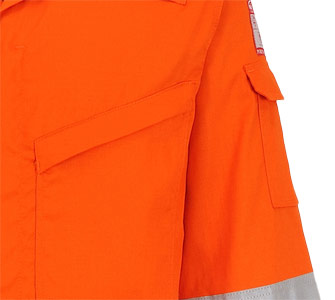
In order to comply with EN ISO 11611 all external pockets must be flapped, except for side pockets below the waist which do not extend more than ten degrees forward of the seam.
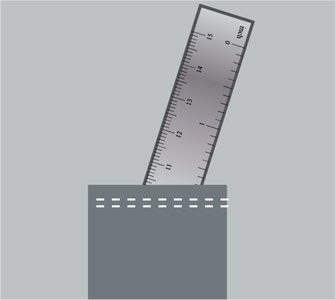
A single rule pocket with an opening not greater than 75mm is permitted behind the side seam on one or both legs.
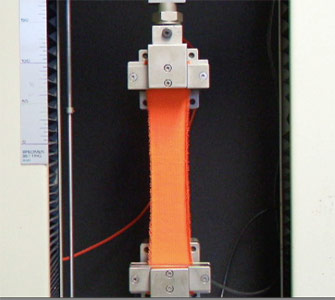
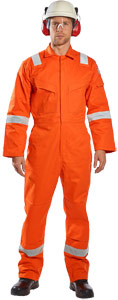
To meet EN ISO 11611 tensile strength must be at least 400N and tear strength must be at least 15N for class 1 and 20N for class 2.
For example:
Portwest's winning FR50 style has a tensile strength value of at least 500N and tear strength of at least 25N after 50 washes.
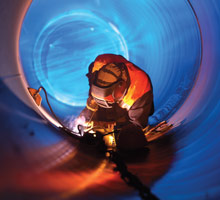
This international standard specifies minimum basic safety requirements and test methods for protective clothing for use in welding and allied processes (excluding hand protection). There are two classes with specific performance requirements.
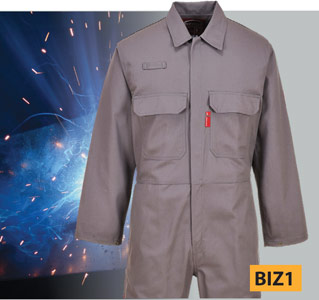
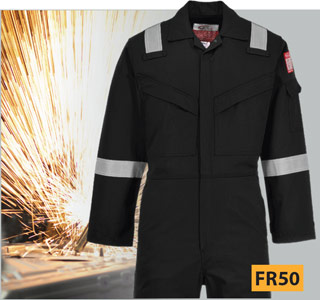
Class 1 is protection against less hazardous welding techniques and situations, causing lower levels of spatter and radiant heat.
Class 2 is protection against more hazardous welding techniques and situations, causing higher levels of spatter and radiant heat.
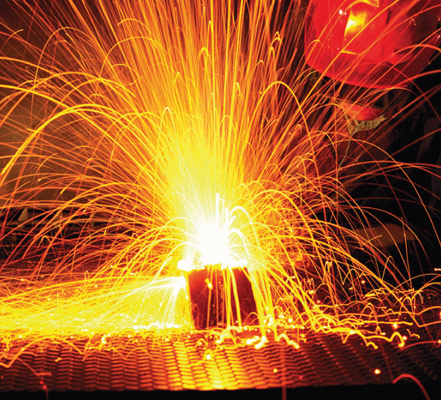
The EN ISO 11611: standard has the following parameters:
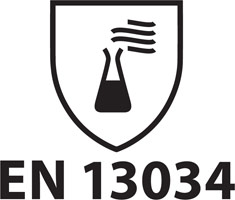
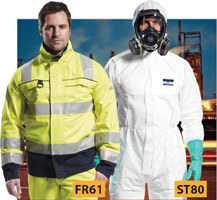
For chemical protective clothing offering limited protective performance against liquid chemicals (Type 6 and Type PB [6] equipment). This standard specifies the minimum requirements for limited use and re-useable limited performance chemical protective clothing.
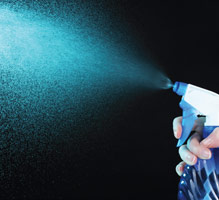
Limited performance chemical protective clothing is intended for use in cases of a potential exposure to a light spray, liquid aerosols or low pressure, low volume splashes, against which a complete liquid permeation barrier (at a molecular level) is not required.
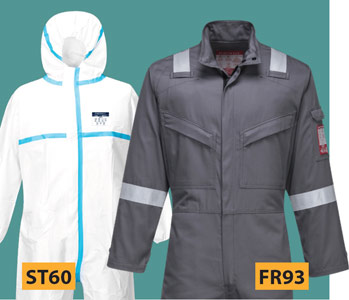
Type 6 Chemical Protective suits must cover and protect at least the trunk and the limbs.
Example: One piece coveralls or two piece suits (with or without hood), boot-socks, or boot covers.
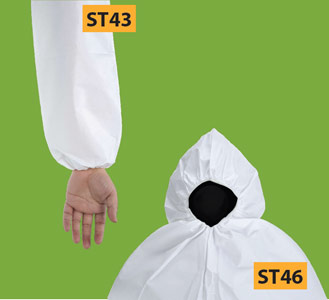
Type PB [6] Partial body protection covers and protects only specific parts of the body.
Example: coats, aprons, sleeves.
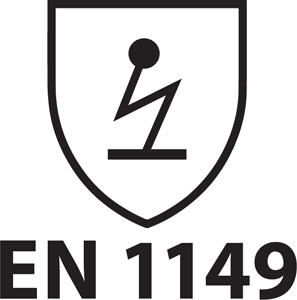
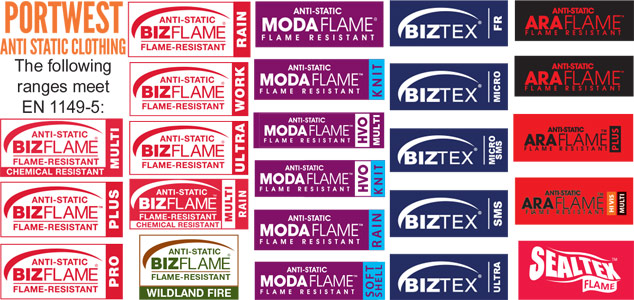
This European standard is part of a series of standards for test methods and requirements for electrostatic properties of protective clothing.
The standard specifies material and design requirements for garments used as part of a total earthed system, to avoid incendiary discharges.
The requirements may not be sufficient in oxygen enriched flammable atmospheres.
This European Standard is not applicable for specifying protection against main voltages.

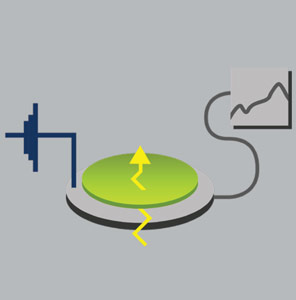
Test method for measurement of surface resistivity. Surface resistance measures the conductivity between two points on the surface of a fabric. The lower the resistance the higher the conductivity, resulting in charge going to earth.
Test method for measurement of the electrical resistance through a material (vertical resistance). This is the level of conductivity when measured through the depth of a fabric.

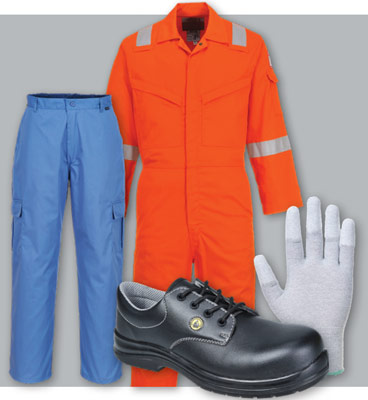
Test methods for measurement of charge decay. Charge decay measures how long it takes for an electric current to dissipate. The quicker it dissipates the higher the anti-static properties of the garment.
Please note the EN 1149-4 Garment Test is under development.
EN 1149-5 specifies the performance and design requirements to avoid static discharge for all electrostatic dissipative protective clothing as part of an entire earthed system, shoes, clothing & floor. The material meets the requirements.


EN 13034 specifies the performance requirements for disposable and re-usable limited performance chemical protective clothing (Type 6 and (Type PB [6]) garments. Limited performance chemical protective clothing (disposable and re-usable) is intended for use in cases of a potential exposure to a light spray, liquid aerosols, low volume splashes and in circumstances where a complete barrier to chemical exposure is not required.
The standard covers both chemical protective suits (Type 6) and partial body protection (Type PB [6])
Chemical Protective Suits (Type 6) cover and protect at least the trunk and the limbs, e.g. one piece coveralls or two piece suits with or without hood, boot-socks, or boot covers.
Partial Body Protection of similar limited performance Type PB [6] covers and protects only specific parts of the body, e.g. coats, aprons, sleeves, etc.


In order to ensure that a chemical protective suit meets Type 6 protection, it is tested using a mist or fine spray of water. The water is dosed with a mild detergent to produce a specified surface tension and injected with a dye to aid the assessment of leakage. The test subject wears an absorbent suit underneath the one to be tested, which absorbs any leaks and is stained by the dye. Success or failure is determined by measuring the total area of any stains on three suits and comparing this with the requirement. Leaks will typically occur at closures and interface areas, but the liquid can also seep through the material itself.
Type PB [6] testing is conducted in a similar way to the Type 6 suit test but only on partial body garments such as sleeves, aprons, coats, etc.

EN ISO 11612 is the standard for protective clothing which protects against heat and flame. Users for these garments include those who work in oil & gas, welding & allied processes, mining, petroleum and many other industries.
There are a host of specific tests conducted as part of EN ISO 11612, including tests for: Flame Spread, Tensile Strength, Tear Resistance, and Heat Resistance.
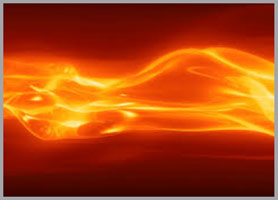
Flame Spread Test:
A flame is held against the fabric for ten seconds. After it is removed the fabric should not continue to burn. There should be no hole formation, melting or molten debris.
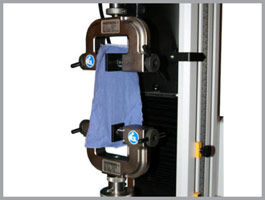
Tensile Strength Test:
The fabric must be able to withstand a minimum force of 300 newtons while being stretched or grabbed.

Tear Resistance Test:
The fabric must be able to withstand a minimum force of 10 newtons before it will tear.
Heat Resistance Test:
The fabric is placed in an oven at 180oC and must not ignite melt or shrink within the first 5 minutes in order to comply with the standard.
Technical stretch workwear with clean professional styling, durable fabrics and coordinated options across everyday trade, eco and FR lines.
Browse the wider WX3 range to compare related styles, features and options in one place.
View WX3 Range Stretch Workwear | CorePro | Eco & FR
This product conforms with essential health and safety requirements as set out in European Directives.
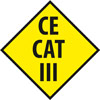
This product is CE marked as a Category 3 item for complex design.

40+ UPF rated fabric to block 98% of UV rays.

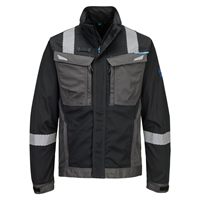
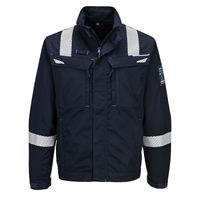
This garment has stretch panelling in key movement areas for greater flexibility.

This garment features 8 pockets.

Portwest has been independently rated by Ecovadis for its environmental, social, and ethical performance and achieved a gold rating, meaning they are in the top 5% of globally rated companies.
The pillars taken into consideration include the environment, labour practices and human rights, ethics, and sustainable procurement.
Modaflame™ Work Stretch is an inherently permanent flame resistant fabric and combines 60% Modacrylic, 35% Cotton, 4% Elastane and 1% Carbon Fibre. Modaflame™ Work Stretch has stretch for ease of movement and greater flexibility, adding to it's comfort, durability and anti-static protection.
Modaflame™ Work Stretch is an inherently permanent flame resistant fabric and combines 60% Modacrylic, 35% Cotton, 4% Elastane and 1% Carbon Fibre. Modaflame™ Work Stretch has stretch for ease of movement and greater flexibility, adding to it's comfort, durability and anti-static protection.
Modaflame™ Work Stretch is an inherently permanent flame resistant fabric and combines 60% Modacrylic, 35% Cotton, 4% Elastane and 1% Carbon Fibre. Modaflame™ Work Stretch has stretch for ease of movement and greater flexibility, adding to it's comfort, durability and anti-static protection.
Modaflame™ Work Stretch is an inherently permanent flame resistant fabric and combines 60% Modacrylic, 35% Cotton, 4% Elastane and 1% Carbon Fibre. Modaflame™ Work Stretch has stretch for ease of movement and greater flexibility, adding to it's comfort, durability and anti-static protection.
Modaflame™ Work Stretch is an inherently permanent flame resistant fabric and combines 60% Modacrylic, 35% Cotton, 4% Elastane and 1% Carbon Fibre. Modaflame™ Work Stretch has stretch for ease of movement and greater flexibility, adding to it's comfort, durability and anti-static protection.
Modaflame™ Work Stretch is an inherently permanent flame resistant fabric and combines 60% Modacrylic, 35% Cotton, 4% Elastane and 1% Carbon Fibre. Modaflame™ Work Stretch has stretch for ease of movement and greater flexibility, adding to it's comfort, durability and anti-static protection.
Modaflame™ Work Stretch is an inherently permanent flame resistant fabric and combines 60% Modacrylic, 35% Cotton, 4% Elastane and 1% Carbon Fibre. Modaflame™ Work Stretch has stretch for ease of movement and greater flexibility, adding to it's comfort, durability and anti-static protection.
Modaflame™ Work Stretch is an inherently permanent flame resistant fabric and combines 60% Modacrylic, 35% Cotton, 4% Elastane and 1% Carbon Fibre. Modaflame™ Work Stretch has stretch for ease of movement and greater flexibility, adding to it's comfort, durability and anti-static protection.
Modaflame™ Work Stretch is an inherently permanent flame resistant fabric and combines 60% Modacrylic, 35% Cotton, 4% Elastane and 1% Carbon Fibre. Modaflame™ Work Stretch has stretch for ease of movement and greater flexibility, adding to it's comfort, durability and anti-static protection.
Hover over the icon (if applicable) for more information
Specifications are subject to change - See Terms & Conditions for more info